A King's Fantasy
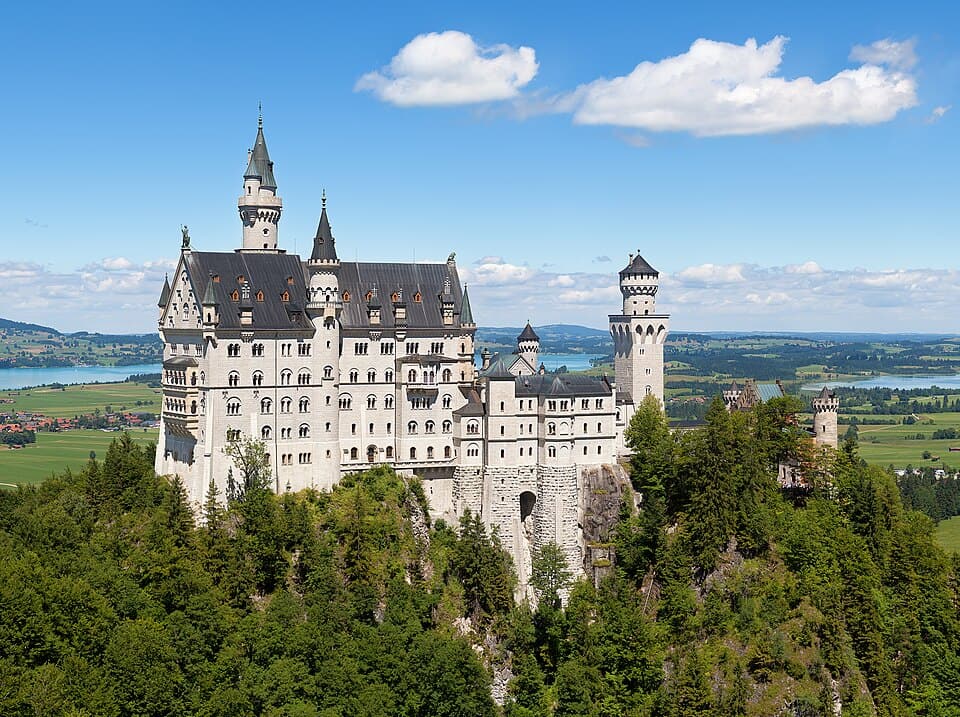
Neuschwanstein Castle was built between 1869 and 1886 for King Ludwig II of Bavaria, a reclusive and romantic monarch who dreamed of creating an idealized medieval castle that would serve as a private refuge from the modern world he found increasingly intolerable. Ludwig funded the castle from his personal fortune and designed it in collaboration with theatrical set designer Christian Jank rather than an architect, resulting in a building that is more theatrical stage set than functional fortress, with every room conceived as a stage for Wagnerian opera. The castle was never completed during Ludwig's lifetime; he was declared insane and deposed in 1886, dying mysteriously just days later in the waters of Lake Starnberg. Ironically, the castle that Ludwig built to escape the public was opened to paying visitors just seven weeks after his death and has since become one of the most visited tourist attractions in Europe.
The Interior
The castle's interior is a lavish tribute to Richard Wagner's operas and medieval German legend, with elaborate murals, gilded carvings, and theatrical room designs that transport visitors into a world of knights, swans, and holy grails. The Singers' Hall, inspired by the Wartburg Castle and modeled after the setting of Wagner's Tannhauser, occupies the entire fourth floor and features an elaborately decorated stage area with murals depicting the medieval song contest. The Throne Room, designed in Byzantine style with gold mosaic walls and a spectacular chandelier in the form of a Byzantine crown, was never completed with its intended throne before Ludwig's deposition. The king's bedroom required fourteen woodcarvers over four and a half years to complete its Gothic canopy bed and wall panels, while the artificial grotto with stalactites and a waterfall connected to his study reveals the depth of Ludwig's escapist fantasies.
The Setting and Views
Neuschwanstein's dramatic setting is inseparable from its appeal, perched at an elevation of 965 meters on a rugged outcrop above the Pollat Gorge with panoramic views of the Bavarian Alps, alpine lakes, and rolling green foothills that stretch to the horizon. The approach from the village of Hohenschwangau involves a steep uphill walk of about 30-40 minutes, though horse-drawn carriages and shuttle buses are available for those who prefer not to walk. The Marienbrucke, a slender iron bridge spanning the Pollat Gorge behind the castle, provides the classic panoramic photograph of Neuschwanstein against its mountain backdrop and is an essential stop despite the queues. Below the castle, the Alpsee lake and the nearby Hohenschwangau Castle, where Ludwig spent much of his childhood, complete a landscape of almost impossible romantic beauty.
Why Visit
Neuschwanstein is the castle of every childhood dream made real, a building so fantastical that it became the literal model for the Disney castle and has defined the popular image of what a fairy-tale castle should look like. Beyond its visual impact, the castle tells the fascinating and tragic story of Ludwig II, a king whose artistic vision and psychological complexity make him one of the most intriguing figures in European history. Whether wreathed in morning mist, dusted with winter snow, or bathed in summer sunshine, Neuschwanstein delivers a visual and emotional experience that few buildings anywhere in the world can match.