A Romantic Fantasy in Stone
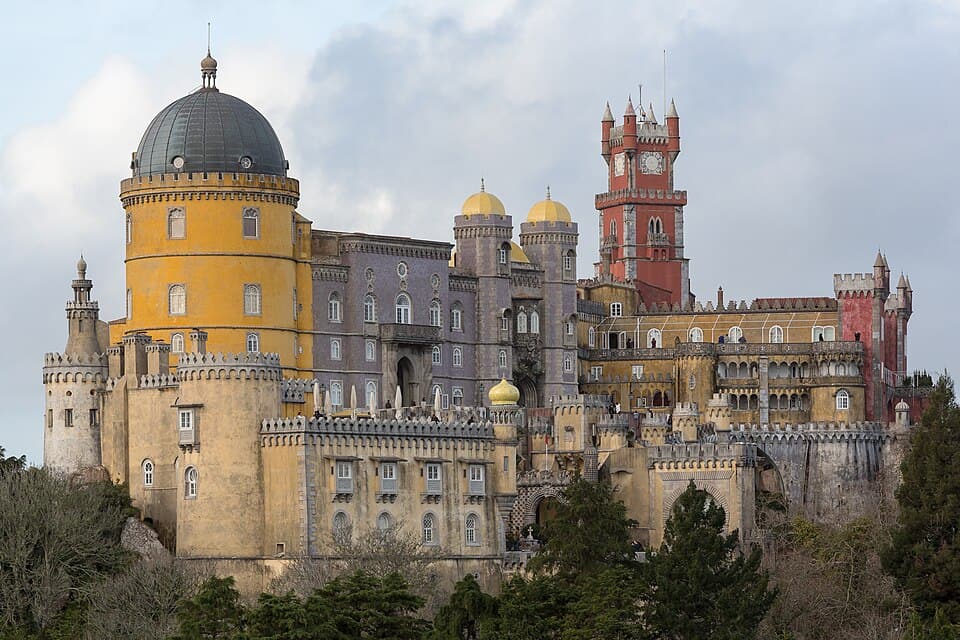
Pena Palace was built between 1842 and 1854 by King Ferdinand II, a German prince with artistic sensibilities and a romantic imagination, who transformed a ruined hilltop monastery into one of the most extraordinary palace complexes in Europe. The palace is a deliberate and exuberant mashup of architectural styles, combining Neo-Gothic arches, Manueline twisted columns, Moorish minarets, and Renaissance domes into a composition that should be chaotic but instead achieves a fantastical unity. Painted in vivid yellow and terracotta red that can be seen for miles, the palace rises above the forested Sintra hills like a scene from a fairy tale, and on clear days it is visible from as far away as Lisbon. UNESCO recognized the palace and the wider Sintra Cultural Landscape as a World Heritage Site in 1995, acknowledging its unique contribution to European Romantic architecture.
Inside the Palace
The palace interior preserves the rooms exactly as they were when the Portuguese royal family fled to Brazil in 1910 following the revolution, providing a remarkable time capsule of late 19th-century royal life. The Arab Room features trompe l'oeil frescoes imitating Alhambra-style decoration, while the opulent Stag Room is entirely covered with naturalistic wall paintings and features antler chandeliers and a spectacular vaulted ceiling. The private apartments of King Carlos and Queen Amelia contain personal belongings, original furnishings, and artworks that humanize the royals who called this fantastical place home. The old monastery chapel, with its altarpiece of carved alabaster attributed to Nicolas Chanterene, provides a contemplative contrast to the palace's theatrical exuberance.
The Park and Gardens
The 200-hectare Pena Park surrounding the palace is a botanical wonderland created by Ferdinand II, who imported exotic plant species from Portuguese colonies around the world, including tree ferns from Australia, camellias from Japan, and giant sequoias from California. The park contains hidden lakes, ornamental follies, a chalet built for the king's second wife Countess Edla, and the Valley of the Lakes, a secluded landscape of interconnected pools surrounded by lush vegetation. Walking paths wind through the forest offering unexpected viewpoints, including the Cruz Alta, the highest point in the Sintra hills at 529 meters, with panoramic views extending to the Atlantic Ocean. The park alone justifies a visit to Pena even for those who do not enter the palace, and its shaded paths provide welcome relief during warm summer months.